How
does the director inform and entertain in the music video ‘Ways to Go’ by
‘GroupLove’
The
music video I have chosen to analyse is by the Rock/indie band ‘Grouplove’. The
music promotions aim is clearly to entertain as a main purpose but also to
inform as a secondary purpose as it shows the band very frequently, in a number
of ways. The narrative behind the music video is very significant as it uses
the concept of North Korea’s controversial dictatorship and uses it as a sort
of parody. This is clearly shown as we see pictures of the main character in
the narrative (the Korean child ) above where the band are playing and another
one above his bed. The pictures are in the stereotypical propaganda style that
North Korea imposes which again implies that this is meant to be a parody of
Kim Jon-un’s life as a child.
Camera
work is used very effectively in order to entertain and inform. Firstly. Camera
work is used to show each member of the band in a number of different ways.
Firstly there is a long shot right at the beginning of the video which shows
all 5 band members having their instruments taken off them by Korean soilders.
This shows the audience immediately who the band are. After the title introduces the song and the
name of the band, the lead singer starts singing and there is a zoom shot used
which zooms into him and keeps the picture of the Korean child behind him, in
the shot at the same time. This is very significant as the camera work has been
used to inform the audience of the band but then also hints at the narrative at
the same time. Soon after this there is a pan shot of the other singer. This
again is used to inform the audience of the band members. After a shot of the
main character in the narrative there are two shots in quick succession, which
show the drummer and the bass player of the band. Both of these shots are
panning shots. The first one gets closer to the drummer and the second one moves away from the bass player.
This again is an example of camerawork being used to inform the audience of the
band members.
Camera
work is also used effectively along with narrative in order to entertain. Firstly at the beginning of the video we get
a hint of the narrative straight away as we see siolders taking the instruments
off the band members in a long shot and then a medium shot of a man holding a
microphone instructing them to play another song. This instantly hints at the
fact that they are being forced to do something and again plays on the idea of
a parody of Kim Jon – Un’s life as a child. Soon after the band start singing
camerawork is used to tell the audience the narrative instantly. As there is a
close up shot of one the pictures of the main character and then a very fast
cut to the next shot of the picture above his bed. After this there is another
fast cut showing two military style speakers and the camera quickly zooms into
them. This now tells the audience within 30 seconds of the video the base line
of the narrative. That the band are being made to play for the child as he is
important and powerful which is shown by the presence of soilders and pictures
of him. The slow motion tracking shot of
the child as he walks into the wardrobe is very significant as it is the first
sign that of the narrative being slightly different to what we might accept.
After these shots, there is a close up of him picking up a shirt which is very
brightly coloured compared to all of the smart dull military style shirts in
the wardrobe next to it. Again this shows a slight twist in the narrative.
Straight after this the shot then switches to a tracking shot as the child
walks down the hall dancing the music. This again reinforces the parody style
approach to the narrative and tells the audience that he is breaking all the
stereotypes of a North Korean dictator as strict and hardline. Other
significant shots include a close up shot of him unlocking the handcuffs of a
prisoner. This again is used to show that the director is breaking all the
stereo types of a ruthless dictator and instead shows him as a peaceful child.
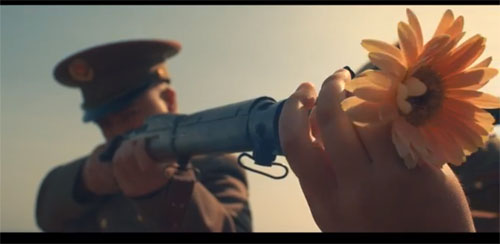
This is also shown with a symbolic close up of a barrel of a rifle in which he
places a flower in the end. This is particularly significant as it confirms his
nature and hints that this maybe what the current child of Kim Jon-Un is
perhaps like or that this is what he was like as a child.
Mise-en-scene
is also used very effectively in order to entertain. For example the costume
that the child is wearing shows that he is choosing to do something different
than what he normally does. The symbology of this could be the idea that we get
up in the morning and we make a choice. A choice to do the same thing everyday
or do something different. That choice can be a positive choice like the boy
choosing the Hawaiian style shirt and happiness over that full closet of
uniforms and hate and oppression.